
PMP® Exam Preparation Bootcamp 2026
Eleven weeks, 22 live classes, 44 contact hours — built on the PMBOK® Guide – Eighth Edition and the PMP® Examination Content Outline that takes effect in July 2026. Every session is live and interactive on Zoom, taught through real project situations from 18+ years of delivery in Bangladesh and abroad.
Why Enroll in This Bootcamp?
Every one of these is included in the fee — the coaching, the mock exams and the mentoring that most 35-hour courses charge separately for, or do not offer at all.
Cohort 04 starts 12 September — seats are limited, so reserve yours early.
Course Outline — 11 Weeks, 22 Classes
- Bootcamp roadmap, learning outcomes and the study commitment this needs
- PMP certification eligibility, the application process, and handling an audit
- The ECO 2026: domains, tasks and enablers; domain weighting and approach distribution
- Exam mechanics — 180 questions, 170 scored, 240 minutes, two 10-minute breaks
- All seven question types, including the new case/scenario and graphic-based items
- Decoding PMI situational questions and the PMI mindset
- The first-attempt strategy — the study plan, question-reading method and exam-day pacing that clears it in one sitting
- Your practice targets, mock schedule and revision cycles; CCR overview
- The Standard for Project Management: purpose, key terms and concepts
- Characteristics of a project; project vs. operations management
- Organizational vs. project governance; portfolio, program, project and operations
- Creating value: value delivery components and assessing project success
- The project environment — EEFs, OPAs, policies, knowledge repositories, structures
- The seven functions associated with projects, and the project management roles
Know exactly what the 2026 exam asks of you and how you will prepare for it, and hold the foundational vocabulary every later week builds on.
- The project management mindset, and how principles connect to the performance domains
- The six principles — Adopt a Holistic View, Focus on Value, Embed Quality, Be an Accountable Leader, Integrate Sustainability, Build an Empowered Culture
- Each principle through project impact, principle in action, and connected domains
- Project phases and phase gates; predictive, adaptive and hybrid development approaches
- Selecting a development approach: deliverable, project and organizational considerations
- Delivery cadence, and the five focus areas from Initiating through Closing
- The project management office: value proposition and customer centricity
- PMO type, model and structure; PMO maturity models
- The PMO's role in governance, standards and tailoring decisions
- Why tailor, and what to tailor — life cycle, approach, processes, engagement
- The tailoring process, from initial approach through ongoing improvement
- Tailoring the performance domains; diagnostics and common situations
Reason from principles rather than memorised process names, and justify why a given project should be run the way it is run — the judgment the situational questions test.
- The Agile Manifesto: four values and twelve principles
- Lean thinking and the inverted constraint triangle
- Iterative, incremental and combined approaches; the development approach spectrum
- The framework landscape — Scrum, Kanban, XP, Lean, Crystal, FDD, DSDM, ScrumBan
- Suitability: when adaptive fits, and when it does not
- Designing hybrid approaches and common hybrid patterns; release planning
- Scrum accountabilities: Product Owner, Scrum Master, Developers
- Servant leadership and self-managing teams
- The five events, the three artifacts and their commitments
- User stories, INVEST, acceptance criteria and backlog refinement
- Relative estimation, story points, velocity, MVP and MBI
- Agile metrics and information radiators — burndown, burnup, cumulative flow, WIP limits, lead and cycle time
- Scaling: SAFe, LeSS, Nexus, Scrum of Scrums, Disciplined Agile
Answer the 60% of items that are adaptive or hybrid with confidence, and recognise which approach a scenario is describing before you read the options.
- Project value creation across the five focus areas
- Governance models: structured vs. self-governed projects; leading and lagging indicators
- Integration, decision-making authority, escalation and success criteria
- Initiate Project or Phase — business case, project charter, assumption log
- Integrate and Align Project Plans — the integrated plan, baselines, plan components
- Plan Sourcing Strategy — insourcing vs. outsourcing, make-or-buy analysis
- Manage Project Execution — issue log, deliverables, work performance data
- Manage Quality Assurance — quality audits, process analysis, quality reports
- Manage Project Knowledge — lessons learned register, information management
- Monitor and Control Performance — dashboards, variance and trend analysis
- Assess and Implement Changes — integrated change control, change requests and log
- Close Project or Phase — transition, final report, archiving, releasing resources
Trace a project end to end through its governance processes, and know which artifact belongs to which moment — the backbone of the Process domain.
- Product scope vs. project scope; scope in predictive vs. adaptive environments
- Scope creep and gold plating — telling them apart under exam conditions
- Plan Scope Management — scope and requirements management plans
- Elicit and Analyze Requirements — interviews, focus groups, facilitation, questionnaires, brainstorming, prototyping
- Requirements documentation and the traceability matrix
- Define Scope — scope statement, product and alternatives analysis, exclusions, acceptance criteria
- Develop Scope Structure — decomposition, WBS and WBS dictionary, scope baseline
- Product backlog and story mapping as the adaptive equivalents
- Validate Scope — inspections and formal acceptance of deliverables
- Monitor and Control Scope — variance analysis; control in backlog-driven delivery
- Tailoring considerations, interactions with other domains, check results
Define, structure, validate and control scope in both predictive and backlog-driven delivery — and know which one the question is set in.
- The project environment, dynamism, and how the life cycle influences scheduling
- Plan Schedule Management — the schedule management plan
- Develop Schedule — activity definition and sequencing, dependencies, leads and lags, path convergence and divergence
- Estimating: analogous, parametric, three-point, bottom-up, relative sizing
- Network diagrams, critical path method and float
- Critical chain and project buffers
- Compression: crashing and fast tracking; resource levelling and smoothing
- Milestone charts, Gantt charts and schedule baselines
- Flow-based and iteration-based scheduling; velocity, throughput, cycle time
- Monitor and Control Schedule — variance analysis, forecasts, burnup and burndown, task and Kanban boards
- Tailoring considerations, interactions with other domains, check results
Build and defend a critical path by hand, and read a burndown or Kanban board with the same fluency — both appear as graphic-based questions.
- Business value, funding strategy and incremental disbursement; cost of quality
- Plan Financial Management — financial management plan and reporting approach
- Estimate Costs — estimating techniques, cost of quality, reserve analysis for contingency
- Develop Budget — cost aggregation, cost baseline, funding requirements, management reserve
- Monitor and Control Finances — variance analysis, reserve management, financial reporting
- Earned value analysis: PV, EV, AC, SV, CV, SPI, CPI
- Forecasting: EAC, ETC, VAC and the to-complete performance index
- Benefit measurement: NPV, IRR, ROI, payback period, benefit-cost ratio
- Tailoring considerations, interactions with other domains, check results
Work every earned value and forecasting formula the exam can ask for, and interpret what the number means for the project rather than just computing it.
- Stakeholder identity, influence, and the cost of engaging too late
- Identify Stakeholders — stakeholder register, analysis, directions of influence
- Plan Stakeholder Engagement — power/interest grid, salience model, engagement assessment matrix
- Manage Stakeholder Engagement — building trust, influencing, negotiation, conflict management
- Monitor Stakeholder Engagement — reassessment and re-engagement triggers
- Plan Communications — requirements analysis, models and methods, the channels formula
- Manage Communications — push, pull and interactive; presentations, information radiators, reporting
- Monitor Communications — feedback loops and effectiveness assessment
- Cross-cultural and virtual team communication considerations
- Tailoring considerations, interactions with other domains, check results
Handle the People domain's hardest items — where the technically correct answer and the PMI-correct answer differ, and stakeholder judgment decides.
- Shared ownership, productivity, and physical vs. team resources
- Plan Resource Management — resource management plan, team charter, RACI and RAM, OBS
- Estimate Resources — resource requirements and the resource breakdown structure
- Acquire Resources — pre-assignment, negotiation, virtual teams, calendars and assignments
- Lead the Team — leadership styles, situational leadership, motivation theories
- Emotional intelligence, team development stages, training and recognition
- Conflict sources and resolution approaches; establishing and enforcing ground rules
- Monitor and Control Resourcing — utilization, physical resource control, performance appraisals
- Tailoring considerations, interactions with other domains, check results
Lead a team the way the exam expects — empowering rather than directing, and resolving conflict at its source instead of escalating it.
- Individual vs. overall project risk; threats and opportunities
- Risk appetite, threshold and tolerance — three words the exam will not let you blur
- Plan Risk Management — risk management plan, probability and impact definitions
- Identify Risks — brainstorming, checklists, SWOT, root cause analysis, prompt lists, assumption and constraint analysis; risk register and risk report
- Perform Risk Analysis — qualitative: P&I matrix, categorization, urgency
- Quantitative: EMV, decision trees, sensitivity analysis, influence diagrams, simulation
- Plan Risk Responses — threat strategies: escalate, avoid, transfer, mitigate, accept
- Opportunity strategies: escalate, exploit, share, enhance, accept
- Contingent response strategies, fallback plans, contingency and management reserve
- Implement Risk Responses — turning planned responses into action; risk owners
- Monitor Risks — reserve analysis, risk audits and reviews, and when a risk becomes an issue
- Tailoring considerations, interactions with other domains, check results
Pick the right response strategy for a threat or an opportunity on sight, and calculate expected monetary value and decision trees without hesitation.
- The procurement process flow, and the roles of project team, procurement and legal
- Make-or-buy analysis; insourcing vs. outsourcing
- Procurement strategy: delivery methods, integrated project delivery, payment approaches
- Bid process and documents — RFI, RFQ, RFP, bidder conferences
- Source selection analysis and criteria
- Contract types: fixed price, cost reimbursable, time and materials, and their variants
- Emerging trends including outcome-based contracts; agreement negotiation strategy
- Managing suppliers, evaluating vendor performance, claims administration and ethics
- Procurement closure and audits
- Artificial intelligence in the project context, and the technologies behind GPTs
- Strategies for AI adoption and the state of the market
- Use cases across the domains — estimating, scheduling, risk identification, reporting, stakeholder analysis, knowledge management
- Complexity and the need for human intervention: where judgment cannot be delegated
- Responsible use — data privacy, bias, transparency, accountability, intellectual property
- Process automation in project work, and resources for continued learning
Close the two areas PMI added most recently — contract selection and negotiation, and the responsible use of AI in project work — then move into full-length mock exams.
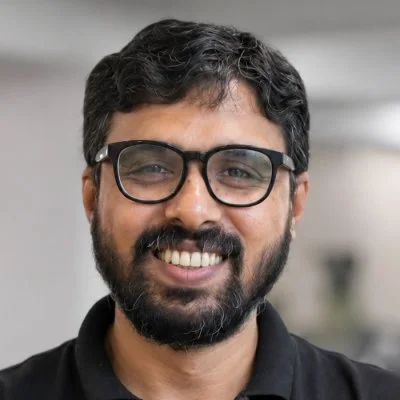
Your Instructor

Faruk has spent over 17 years delivering software projects and products across SaaS platforms, FinTech, microfinance and core banking, and the hospitality sector — more than twenty of them large-scale — running them predictively, in Agile-Scrum, and in the hybrid arrangements most organisations actually live with. That range is the point: the 2026 exam splits its questions roughly 40/60 between predictive and adaptive or hybrid approaches, and he has managed projects on both sides of that line.
He has delivered in 7 countries, including Bangladesh, Bhutan, Afghanistan and Myanmar, partnering with organisations in each and working with senior management, technical teams and end users alike. The situational questions that decide a PMP result are drawn from exactly these situations — a sponsor changing scope late, a vendor missing a milestone, a team that has stopped talking to each other — and each one is taught here from a project he actually ran, not from a slide.
He also shares the preparation and exam-day strategy he coaches candidates through for a first-attempt pass: how to build the study plan, how to read a situational question before looking at the options, and how to pace 180 questions across 240 minutes without running out of either time or concentration.
View LinkedIn ProfileWhat the Programme Covers
Cohort 04 starts 12 September, and seats are limited so every participant gets their one-to-one coaching time.
No commitment required — our team will contact you within one working day. Questions first? Call or WhatsApp +880 1712-295378.
The fee above covers this bootcamp only. PMI's own application and examination fees are paid directly to PMI and are separate.
What Project Leaders Say
"Before joining the bootcamp, I wasn't confident about taking the PMP exam and was quite confused about where to start. Faruk Bhai's regular mentorship, beyond the course content, gave me the confidence and direction I needed. The mock exams were especially helpful in preparing me for the real exam, and I successfully passed on my first attempt. Highly recommended!"

"The PMP Bootcamp was highly practical and engaging. Real-life project examples made complex concepts easy to understand. The instructor's regular follow-ups kept me motivated and on track. Interactive sessions and short quizzes after each topic helped reinforce my learning and boosted my confidence for the PMP exam. I highly recommend this bootcamp to PMP aspirants."

"I had a great learning experience throughout the PMP course with Mohammad Faruk Bhai. One thing I really appreciated was that he randomly asked questions during the sessions, which kept everyone engaged and encouraged us to stay prepared. I also found the module-wise exams after completing each module very effective for reinforcing the concepts. The mock exams were another valuable part of the learning process, as they closely resembled the actual PMP exam and helped me identify areas for improvement. Overall, his structured teaching approach and continuous guidance played an important role in helping me achieve my PMP certification."
Frequently Asked Questions
Ready to Put PMP After Your Name?
Cohort 04 starts 12 September. Eleven weeks of live classes, 44 contact hours, four full mock exams — and someone in your corner until you have passed.
Call or WhatsApp +880 1712-295378 · support@mentogrid.com